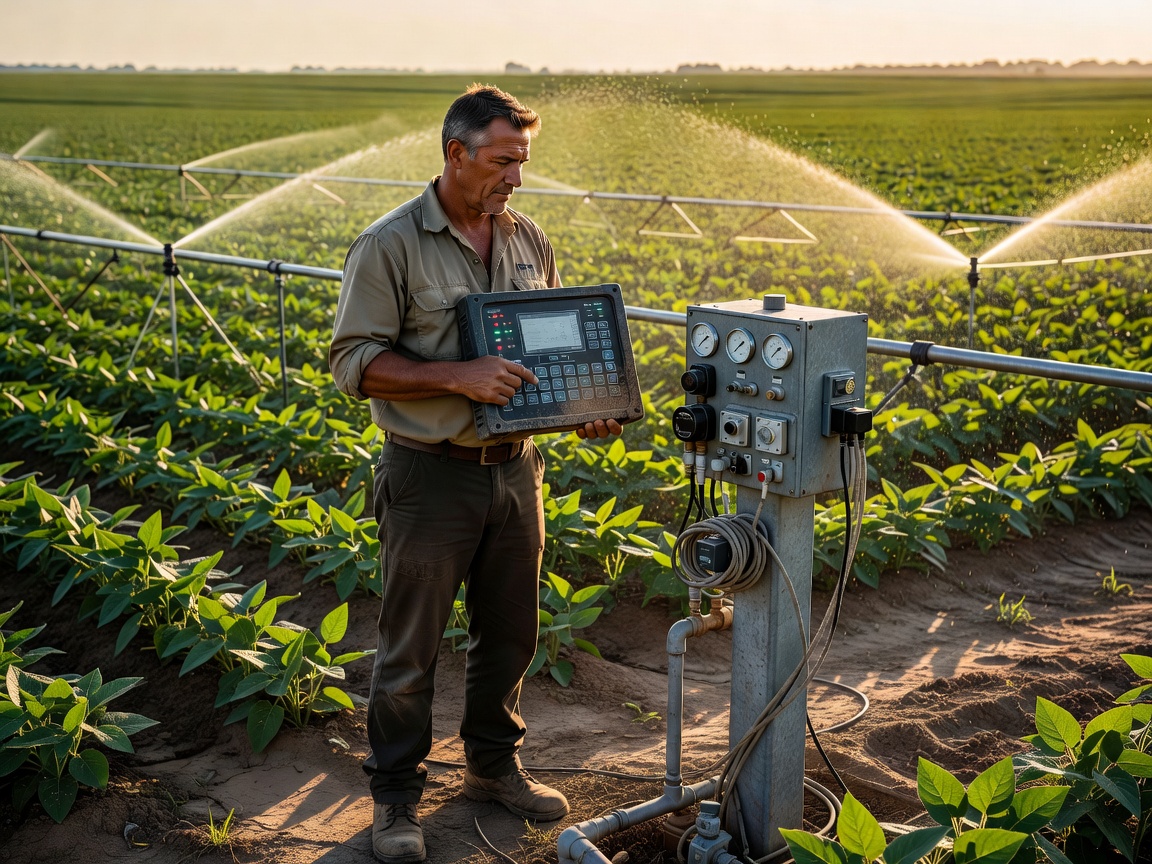
An irrigation schedule is a plan for when, where and how water should be applied. Automated controls can open valves, start pumps, respond to sensor thresholds and create event logs. They cannot decide whether every input is representative or whether a real-world system is delivering as planned. The operator’s job is to connect the schedule with crop needs, soil conditions, weather, hydraulic capacity and field observations.
Define the management unit and objective
Begin with the crop, field, growth stage and irrigation method. Identify the management zone the schedule is meant to serve. A block with uniform crop and equipment may be managed as one zone; significant differences in soil, planting date, slope, rooting conditions or water supply can make a single rule less meaningful. The aim is not to create endless zones, but to use units that reflect practical differences and can be operated reliably.
Clarify the objective. A schedule may aim to avoid prolonged water stress, support establishment, protect a sensitive growth stage or respond to uncertain rainfall. Keep the objective specific enough to guide decisions without pretending the system controls every source of variation. Local water allocations, restrictions, labor, energy, infrastructure and crop management can shape what is feasible.
Choose inputs with known limitations
Soil measurements help describe moisture status at installed locations and depths. Before using thresholds, identify what the sensor reports, how it was installed, whether it was calibrated for the soil and how it compares with field checks. A sensor threshold should be treated as a decision aid, not a universal trigger. Validate it over representative conditions and revise it as rooting depth or crop stage changes.
Weather-based estimates use observations such as temperature, humidity, wind, rainfall and solar radiation. Reference evapotranspiration and crop coefficients can help estimate crop water use, but estimates rely on methods and assumptions. A weather station far from the field, missing data, a changed canopy or a local shower may affect how well the calculation represents a particular zone. Keep track of the source, period and assumptions used.
Crop stage matters because demand and sensitivity vary over the season. A crop coefficient or stage-based allowance is a model input, not a direct measurement of every plant. Consider rooting constraints, cover, irrigation method and the likely effective rainfall. Check field observations in context and avoid interpreting one visible symptom as a definitive measurement of water stress.
Translate a plan into system capacity
Scheduling must account for the distribution system’s real flow and pressure limits. Confirm which zones can run at the same time, how long they require, and whether the source can meet the proposed sequence. The application rate should be considered alongside soil intake and the risk of runoff, ponding or deep percolation. A duration that is suitable for one soil and equipment combination may not be suitable for another.
Build clear operating rules: a start condition, permitted operating window, maximum run time, stop condition and a response if a sensor or communication link fails. For a threshold-based controller, specify how many readings or how much persistence is needed before action, where the sensor sits and what action follows. Set limits that make sense for the pump, water supply and crop rather than assuming the automation can solve a capacity mismatch.
Use a fallback plan. Decide who will notice a power interruption, stuck valve, missing data or unexpected rainfall and how manual operation will be handled safely. Keep operating instructions accessible. A system that is understandable by the people who maintain it is more resilient than one whose logic is known only through a vendor interface.
Build the record into the routine
Record scheduled and actual events separately. A command in a controller log shows what the system was instructed to do; it does not prove that a pump ran or that water reached a root zone. Record zone, start and stop times, rainfall, readings used, changes made and any exceptions. Give zones consistent names across sensor dashboards, valve labels and field notes.
Review the schedule after meaningful weather changes, crop-stage changes, repairs or unusual field observations. Do not let a fixed program continue simply because it ran last week. At the same time, avoid making repeated adjustments based on a single noisy reading. Verify the data, check the equipment and document why a change was made so the next review has a usable history.
Close the loop with field checks
After a run, confirm valve and pump operation and inspect representative locations. Look for blocked outlets, leaks, runoff, ponding and patterns that suggest uneven delivery. Check soil moisture at relevant depths when practical. Compare actual observations with the expected response and update the schedule only after investigating discrepancies.
Evaluation should be proportional to the decision. A small change to one zone may call for a straightforward inspection and note; a significant shift in crop, equipment or control logic may justify a more careful review. Keep measurements and assumptions visible. A schedule is a working hypothesis about water need and delivery, revised as evidence accumulates.
Automation can support consistency and make observations easier to use, but it does not guarantee water savings, yield or crop quality. Outcomes depend on local conditions, design, maintenance, management and the accuracy of inputs. The most useful schedule is one that is explainable, adjustable and checked against what happens in the field.